Rhododendron
Rhododendron (from Ancient Greek ῥόδον rhódon "rose" and δένδρον déndron "tree")[2][3] is a genus of over 1000 species of woody plants in the heath family, either evergreen or deciduous. Most species have showy flowers.
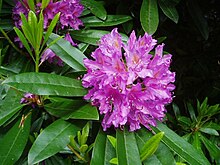 Azaleas make up two subgenera of Rhododendron. The flowers of some hydrangeas can appear similar to those of some rhododendrons, but Hydrangeais in a different order.
The rhododendron is the national flower of Nepal.
Description
 Rhododendron is a genus characterized by shrubs and small to (rarely) large trees, the smallest species growing to 10–100 cm (3.9–39 in) tall, and the largest, R. giganteum, reported to over 30 m (98 ft) tall.[4] The leaves are spirally arranged; leaf size can range from 1–2 cm (0.39–0.79 in) to over 50 cm (20 in), exceptionally 100 cm (39 in) in R. sinogrande. They may be eitherevergreen or deciduous. In some species, the undersides of the leaves are covered with scales (lepidote) or hairs (indumentum). Some of the best known species are noted for their many clusters of large flowers. There are alpine species with small flowers and small leaves, and tropical species such as section Vireya that often grow as epiphytes. Species in this genus may be part of the heath complex in oak-heath forests in eastern North America.[5][6]
Cultivation
Both species and hybrid rhododendrons (including azaleas) are used extensively as ornamental plants in landscaping in many parts of the world, and many species and cultivars are grown commercially for the nursery trade. Rhododendrons are often valued in landscaping for their structure, size, flowers, and the fact that many of them are evergreen.[12] Azaleas are frequently used around foundations and occasionally as hedges, and many larger-leafed rhododendrons lend themselves well to more informal plantings and woodland gardens, or as specimen plants. In some areas, larger rhododendrons can be pruned to encourage more tree-like form, with some species such as R. arboreum and R. falconeri eventually growing to 10–15 m or more tall.[12]
Culture
Symbolism

Rhododendron arboreum (lali guransh) is the national flower of Nepal. R. ponticum is the state flower of Indian-administered Kashmir and Pakistan-controlled Kashmir. Rhododendron niveum is the state tree of Sikkim in India. Rhododendron is also the state tree of the state of Uttarakhand, India.
Rhododendron catawbiense, the most widespread rhododendron of the Appalachian Mountains, is the state flower of West Virginia, and is in the Flag of West Virginia. Rhododendron macrophyllum, a widespread rhododendron of the Pacific Northwest, is the state flower of Washington.

Literature
In Joyce's Ulysses, rhododendrons play an important role in Leopold and Molly's early courtship: Molly remembers them in her soliloquy - "the sun shines for you he said the day we were lying among the rhododendrons on Howth head in the grey tweed suit and his straw hat the day I got him to propose to me". Jasper Fforde a British author, also uses rhododendron as a motif throughout many of his published books. See Thursday Next series,[34] and Shades of Grey.[35]
Culinary
In Nepal, the flower is considered edible and enjoyed for its sour taste. The pickled flower can last for months and the flower juice is also marketed. The flower, fresh or dried, is added to fish curry in the belief that it will soften the bones.

.jpg "Machapuchare")
